 08/28: I can't believe it's been almost half a year since all this quarantine and work from home stuff first began. During this time, Tiffany, Amias, and I have all gotten a year older. Tiffany and I also celebrated our five-year wedding anniversary. Of course, all of these occasions were marked much more quietly than what we would ideally have wanted. But other than that, I've been enjoying having plenty of time to be home even while working. Honestly, a part of me wishes things won't have to go back to normal. But the fact is that sooner or later, I'll be returning to the daily busyness of waking up before sunrise to catch the train and having only a few precious hours to enjoy at home before sleeping. I was just informed not long ago that, in a few weeks, my co-workers and I should expect to start reporting to the office twice a week. That certainly isn't much, but compared to currently going in only once a week (and previously even less than that), it seems like a pretty significant change.  07/07: Over a year ago, my daily commute to and from work in Downtown L.A. was transformed thanks to the purchase of a Glion Dolly Model 215 electric scooter. I had wanted an e-scooter for quite some time already, but only plunked down the money after Metro made the decision to start charging for parking at every Gold Line train station east of Pasadena. I'll save that rant for another day, but right now I'll gladly say that Metro's move (which I still believe is, for many reasons, completely stupid and unjustified) has actually worked in my favor. Over the past year, I've enjoyed roughly 450-500 miles on the Glion, mostly to get to and from train stations, plus the occasional lunch break joyride or grocery store run. Sure, there are many drawbacks to using a scooter, and navigating L.A.'s busy streets while fully exposed to the elements certainly takes getting used to. But after a year, I have absolutely no regrets. 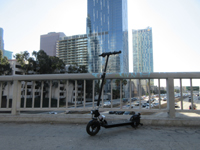 Cost: My Glion cost $499.99 (plus a $39.00 optional scooter cover) at the time of purchase. It may sound like a large amount of money for what seems like basically a fancy version of a kids' toy. But consider that Metro charges around $60 a month for station parking. By eliminating the need to drive to/from the station, I save not only the parking fee, but also money for gas and car maintenance. If you want to get more familiar with scootering before committing to a purchase, you can always spend a buck or two and play with one of those many rental scooters sitting on the sidewalks. But if you're going to use it for daily commuting, the cost of buying your own scooter may be a good investment. Needless to say, my investment has certainly paid off. Glion has already released a new Model 225 scooter, which not only features several improvements over the 215, but also costs less ($429.99)! With scooters getting increasingly popular (especially in large cities), it's no surprise that the technology will improve over time while the price will decrease. With my scooter still working perfectly fine, I have no plans for a replacement anytime soon. But I'm sure that when that time comes, I'll be pleasantly surprised. Time: In December, my office had an off-site gathering just over a mile away. A co-worker saw me while stopped at a red light and offered a ride. I kindly turned down his offer - and beat him to our destination. Sure, a top speed of 15 mph isn't fast. But keep in mind that city streets often cosist of traffic jams, frequent red lights with long pedestrian crossing wait times, and various obstacles such as stopped busses or construction zones. Plus, in the time it takes to drive in/out of a parking structure, find a parking spot, validate or pay for parking, and walk to/from the actual destination, I can literally be halfway across Downtown L.A. already. Yes, for longer-distance trips or long stretches of open road, I'm clearly at a disadvantage. But when it comes to short commutes or busy streets, there's no doubt a 15-mph scooter is no slower than a car. In fact, by using the Glion to get to and from train stations before and after work, my overall daily commute time is now actually a few minutes shorter than it was when I drove to the stations back in the old days of free parking! Convenience: There's no doubt that scootering has many obvious drawbacks, including the lack of any cargo space and the threat of rain or other harsh weather. There are certainly times when a scooter isn't a smart or safe choice. But for the most part, all it takes is a little wise planning. On days with rain on the forecast, I still have the option of driving to the train station and either playing for a single-day parking pass or finding street parking farther away and enjoying a little walk. (And if it's not actually raining, I can always still use the Glion until it is! The scooter is technically water-resistant, but unless it's only raining lightly, I prefer not to take my chances for simple safety reasons). As for carrying cargo, I've learned to always bring a foldable grocery bag with me in case it comes in handy (which it does - every time there's an office party with leftover food!) I've used the Glion to carry alcoholic beverages, baby supplies, take-out meals, two dozen donuts to treat my co-workers, and a 25-lb bag of flour. Okay, fine, maybe that last one wasn't such a smart idea (it was a last-minute decision!). But I managed to balance it on the mainboard between my feet and successfully transport it home so my wife could bake up some delicious treats. One of the Glion's most unique and recognizable features is its "Dolly mode". To be honest, I didn't think too much of it when I first bought mine. But now, I don't know how I'd live without it. Carrying around a 28-pound scooter can be quite a workout, and the dolly feature not only helps ease that burden significantly, but also allows me to maintain a professional image in the office. Just arrive at the door, fold up the scooter in a few seconds, and take it with you to your cubicle. Unlike with a car, you don't have to worry about traffic jams, parking fees, or finding a space. Unlike with a bike, you don't have to worry about thieves or be forced to wait for the next train or bus when there's not enough space. And unlike with rental scooters, you don't have to waste time looking for an available ride (or deal with potential sanitary concerns that are especially important in this pandemic season). It may not be for every situation, but for the right situation, the Glion certainly works wonders. Safety: One of the first things people ask me when they see me with a scooter is, "is it safe"? To put it simply, yes. The Glion's controversial electric brake takes getting used to, but works fine once you're used to it. In terms of safety, the only thing that really needs improvement is the lighting - the unusually low position of the headlight makes it ineffective in both lighting the path ahead and being seen by drivers. An actual taillight (rather than a reflector) like many scooters have wouldn't hurt either. Thanks to a $12.99 set of portable bike lights, the issue was easily resolved. Other than that, the bottom line when it comes to safety is to simply use your head and not be an idiot. Water is wet (and slippery). Bumps can make you fall. Objects bigger than you (i.e. cars) can kill you. Any form of distraction or emotional distress will make you less likely to respond to hazards in a safe and timely manner. Keep these things in mind, and you'll be at least as safe on a scooter as you are when walking. Otherwise, you'll be putting both yourself and those around you at risk, no matter what mode of transportation you're using. With all that said, I'm glad to know that my Glion has been a worthy investment. Aside from the inevitable scratches and some small broken parts (that have minimal effect on regular use), the scooter still runs as good as new after over a year. There's definitely room for improvement; in my imaginary perfect world, the Glion would have suspension (which I believe the Model 225 has), better lighting, and maybe some mode settings to temporarily boost power while going uphill (the Glion has no problem going up most hills, despite a noticeable reduction of speed) and maintain steady speed while going downhill. But in that world, scooters would probably be able to fly, too. To me, what truly makes a good commuter scooter is its ability to balance all of the categories mentioned above. Sure, everybody can wish for less weight, more power and speed, better quality, and less cost, and there are plenty of other scooters on the market that can satisfy each of those specific wishes - but only at the expense of others. One other selling point of the Glion for me was that, as shown in numerous customer reviews, the company does not skimp out on good service. Thankfully, my scooter hasn't had any issues that required me to contact them. But Glion did send me a free T-shirt in response to me submitting some photos of my scooter for a contest (which I sadly didn't win) - an unexpected kind gesture, especially during the current pandemic when so many people and companies are facing financial challenges. While I use my scooter for practical purposes, I certainly can't deny that it's also a heck of a lot of fun. It didn't take me long after buying the Glion to discover that it's an excellent conversation starter. Random people both on the train and in the office will often ask me about the scooter. Dolly mode seems to attract the most attention, especially when the scooter is wearing its cover; numerous people have asked me if I was carrying a musical instrument or a set of golf clubs. A few people even wanted to take pictures of it. A girl in my office who I had previously met saw me riding toward the entrance and beamed with excitement as she told those next to her about how she had seen my scooter quickly fold up, get covered, and be rolled into the building like a luggage - something I gladly demonstrated again to her delight. Sometimes it almost feels as if I were driving a fancy sports car - only for a tiny fraction of the cost. Yes, I've received negative comments too, courtesy of those who dislike scooters in general thanks to the many idiots who use rental scooters to zip around busy sidewalks or dump them in obstructive places afterwards. Unfortunately, there's nothing much I can do to improve that situation other than to ride respectfully and not be an idiot myself. But I certainly believe that the rental scooter industry has played a crucial role in advancing the technology that makes today's scooters as good as they are. And as time moves forward, there's no reason to doubt that scooters will only continue improving. The Glion T-shirt serves as a great reminder to me that scootering is not only a practical commuting method or a fun activity, but also a lifestyle - something that you love despite its drawbacks, and something that those around you will easily identify you with. The fact that people of all age groups, social classes, and ethnic backgrounds have expressed interest and curiosity in my Glion testifies to its ability to bring people together and help them connect despite their differences. With or without all the attention, the Glion is something I've taken great pride in. There's nothing like the feeling of fresh wind in my face to wake me up early in the morning or help me relax after a long day in the office. Whether it's after a sleepless night or a stressful day, it's hard to hop on the scooter and not feel the excitement of a child out to play. Who would have guessed that a daily commute that most people associate with boring traffic jams could actually be so enjoyable and so affordable? I'm certainly glad to have chosen this lifestyle, and look forward to many more great scooter adventures in the months and years to come! |