 January - February, 2021
02/18: The pandemic has prompted many of us to seek creative ways of making up for experiences that are now either unavailable or unsafe. Through doing so, we often discover that we're able to do a lot more than we believed, and that our homes can be a lot more useful and entertaining than we had thought. Tiffany and I haven't gone out to eat much ever since the baby was born, since the inconvenience of doing so made it much less stressful to just eat at home. Once the pandemic came and people were advised to stay at home, we stopped eating out completely, opting to either order take-out food or cook at home. Honestly, I actually enjoy this lifestyle. We save an incredible amount of money and eat food that's generally more healthy (if cooked at home). There's no worries of dealing with idiot drivers, long wait times, or bad service. Childcare accomodations are easily accessible. And when alcoholic beverages are involved, transportation isn't an issue. But the one thing I really miss most about going out to eat is enjoying the experience of fine dining - those rare but memorable occasions when, after having gradually saved up enough money to ease all worries, I take Tiffany to a fancy restaurant where the food, service, and ambience is rightfully nothing short of excellent. We can simply sit down and enjoy every moment of the experience, focusing on the joy of our relationship while leaving all of life's worries back at home.
When it came time to plan for our Valentine's Day dinner, we both knew that given all the pandemic-related uncertainties, it was probably best to eat at home. So I decided to come up with some practical but effective ideas to make our at-home celebration no less memorable than going out for a fancy dinner date. My goal was to create an experience that not only took us away from home, but also deserved a five-star Yelp review if it were a restaurant.
-Choosing the right food: Needless to say, a meal isn't really a meal without food. We opted for a huge take-out sushi and sashimi platter; for us, it's something more special than what we get to eat on a regular basis, and it's also a lot easier to manage and enjoy as a take-out than many other common fine-dining menu items. (A steak simply isn't the same unless eaten right when it's served!) In keeping with the Japanese theme, we prepared a bottle of sake and ordered a Japanese cheesecake for dessert. For around the same price as a typical high-end dinner at a restaurant, we were able to get a platter that not only had excellent quality, but also was big enough for us to stuff ourselves as if we were at an all-you-can-eat restaurant. When it comes to choice of food, it's ultimately not about how fancy it is or how much it costs, but really what works best for your location, your occasion, your budget, and your significant other. Choosing a particular cuisine or theme and preparing drinks and desserts to fit the theme certainly helps, though. And if you're gifted in cullinary arts, it may not hurt to put those skills to use, though you don't want to end up too exhausted to actually enjoy the meal!
-Cleaning/decluttering: Most people don't realize how messy their homes are, simply because they've gotten used to seeing the same pile of clutter in the same corner week after week. If the clutter actually belongs elsewhere, this is a good chance to move it where it belongs. Even if there's no better place to put it, just temporarily move it out of sight. Consider using a portable divider wall, drape, or other item if it helps. The more clutter is within view, the easier it is to be reminded of work, chores, or other worries that don't belong at the dinner table. So get those things out of sight and out of mind. Oh, and don't forget to do at least a little cleaning. Spiderwebs, dirty furniture, excessive dust, and trash on the floor are all unwelcome surprises at a restaurant!
-Decorations: With the unnecessary things now out of sight, it's time to focus on things to keep in sight. Depending on the occasion, simple decorative items can really help set the right mood. I opted for a newly purchased red tablecloth paired with a set of red lampshades that the previous owners of our home left behind, which worked great with the dark wood color of our furniture. Believe me, something as seemingly simple as changing the color of the tablecloth and lampshades makes a huge difference. If it helps, try turning the table a different direction or sitting somewhere other than your usual spot at the table, just to create a sense of freshness. Flowers would have been a great option too, but with the huge sushi platter on our table there was simply no room for tabletop decorations. Use diningware that fits the occasion; fancy-looking disposable items may do the part, but it certainly doesn't hurt if you have a nice set of dishes, especially ones you don't use on a regular basis. And no, having to wash dishes afterwards is not a good excuse!
-Lighting: We're blessed to have a dimmer on our dining room lights, and in this case, it really makes a difference. Candles would have added a romantic touch, though I opted out for the same reason as the flowers. The most important thing about lighting is to draw focus to the right places and away from the wrong places. Generally speaking, use lights only at/near the dining area. Turn off TV's, computers, and other screens that may cause distraction. Turn off lights in rooms and areas that don't need to be seen. (This helps hide clutter, too!) Close window blinds/curtains to avoid distraction unless the view is part of the desired ambience. Decorative lighting in reasonable amounts can be a nice touch, too. One thing I wish to do for future at-home parties or fancy dinners is to hang up icicle lights. Note to self: don't procrastinate after Christmas this year and get a bunch of lights while they're on clearance!
-Music: Close your eyes, listen to the right music, and it can take you to places you never even knew existed. If you don't have an existing sound system nearby, simply chain up a few sets of cheap computer speakers and connect them to a device that plays music. This can easily be done for less than the price of a pair of drinks at the bar for you and your date. If you don't have a dedicated audio player, it's okay to use a computer or phone. But remember, the point is to have ambient music with no distraction or interruption. That means avoiding anything with commercial breaks. If using a phone or computer, make sure texts, calls, apps, and other potential interruptions are either disabled or silenced. Don't use random playlists, but rather choose music that intentially sets the right mood. You can use a CD, a digital album, or a YouTube track. (For the last option, I suggest using an ad-blocking browser extention. It's free, fully legal, and can change your life.) Choose something that's at least half an hour long (if not longer), set it on repeat, and you're good to go. If it helps, close any windows or turn off any devices that may cause unwanted noise or distraction, unless it is part of the desired ambience. In our case, we opted for a Japanese jazz piano album - it fit with the theme of our cuisine, and a little jazz always helps set a classy and romantic mood!
-Attire: Yes, we decided to dress up for dinner at home. After all, that's what we would have done if it were an expensive, dimly-lit restaurant with jazz music in the background. Okay, fine, we did everything except the shoes; after all, we're in an Asian home. When it comes to each of these aspects of preparation, the bottom line is to not be lazy or take shortcuts. Five-star Yelp review, remember? Think of it this way - when you take a girl out on a first date, don't you gladly look your best and act your best? As a relationship becomes burdened with responsibilities rather than pleasure, it's too easy to settle for mediocrity. That's why you need to think outside of home. Detach from the couch potato, workaholic, or self-indulging life that may define you at home, otherwise you won't be able to create and enjoy an experience that takes you out of home. Treat this like you're preparing for the best night of your life, and you'll be amazed what can be accomplished under the roof of your own home.
After all the preparations were done, Tiffany helped put the baby to sleep while I went to pick up the sushi. Then it was time to party. We began with Midori-based cocktails - Tiffany's favorite, and also fitting for the Japanese theme. Quick tip: Alcoholic beverages are one of the quickest ways to burn through your wallet at restaurants. If you go out to drink often, try learning to mix some simple drinks at home, and you'll quickly save up enough money to make noticeable improvements in all of the above mentioned areas. The one primary downside of creating a fancy restaurant experience at home is that in the end, somebody has to do refill drinks, grab napkins and utensils, and do all the work that you would normally tip somebody to do. But come on, guys, ladies love a guy who's willing to serve her! So unless you bribed a friend into being your butler for the night, just get up on your feet and do a few acts of service. This brings up another important tip - it may be a good idea to choose a type of food that doesn't require excessively getting up to serve or prepare, which may distract from the overall experience. Remember, it takes both of you to enjoy a dinner date together!
And enjoy we certainly did. Several hours flew by. We ate and drank so much that we craved nothing else. We talked and enjoyed each other's company, leaving behind any worries and celebrating our relationship. Sitting at the same table we sit at for dinner every day, we literally forgot that we were still at home. And that alone left me assured that everything that went into making this night happen was certainly worthwhile.
 
The best thing about this is that it can be done anywhere by just about anyone. You don't need a lot of money or a big house. I can honestly say that if Tiffany and I still lived at our old apartment that was half the size of our current condo, I could have pulled off pretty much the same thing. Yes, some homes and rooms may be easier to work with than others. But the important thing is to be creative. It's certainly good to be budget-conscious (and trust me, it's amazing how much money you can save for home upgrades just from not eating out!), but when it comes to being lazy or settling for mediocrity, there's no one to blame but yourself. A little effort and a little creativity can go a long way. If you don't think you're a creative person, feel free to use my ideas, or do a little research online. In fact, by creating a special dining experience at home, you can do even more than what restaurants can by creating a unique experience designed specially for yourselves - your favorite food, your favorite colors, your favorite music, all enjoyed in the comfort of home. And in the end, you may end up at the same conclusion that Tiffany and I reached - that we're so blessed to be where we are, and wouldn't choose to be anywhere else!

01/30: I have no shame being a Neanderthal when it comes to technology. Rather than seeking the bragging rights of having the latest electronic gadgets, I've always preferred to invest in things that have stood the test of time and proven themselves worthy. Besides, there's never a shortage of people who will gladly pay a premium to fund the continued progress of technology while filtering out what works from what doesn't for people like me to snatch up at a discount. Recently I embarked on my latest home improvement endeavor - an audio system for my living room to play ambient music for various occasions, whether it's a morning coffee break, Amias' play time, a party with friends, or a romantic dinner.
Most people agree that a little background music can work wonders in transforming a social gathering into a festive party or a take-home meal into a fancy dinner date. And there are countless simple ways to make it happen in just about any home, whether it's with an old boombox or with a new iPhone. But why do so many people still choose to do without it? I believe many times it's because it either takes too much work or is too inconvenient. In our fast-paced (and often lazy) world, having to repeatedly switch CD's, browse for mp3's on complex operating systems, or wait more than few seconds for systems to load simply doesn't seem to be worth the time. Yes, I know, there are several "smart" systems now that will play music with a simple voice command. But this is where my Neanderthal instincts kick in. I don't want to deal with spotty wi-fi signals, bad Bluetooth connections, or robots constantly monitoring my words and potentially interrupting priceless moments or conversations; if ambient music at a fancy restaurant should play without interruption, then so should the music in my living room. So I opted for a good ol' wired setup using 3.5 mm inputs/outputs (commonly known as standard headphone jacks/cables), so that just about anything - a computer, a boombox, a phone, a handheld video game console, you name it... - can be connected. And thanks to a couple sets of decent-quality old speakers placed in different parts of the room and a few budget-friendly 3.5 mm extension cables from Amazon (including a splitter for multiple outputs), an ambient surround-sound effect was easily achieved.
With the sound system complete, it was time to select a most suitable audio player, specifically an mp3 player due to its small size and ability to store and play through a seemingly infinite number of tracks. While an mp3 player may seem like the obvious choice compared to a traditional CD player, there are actually many potential drawbacks. That's why I came up with several specific criteria, all of which must be met for me to select my most suitable living room mp3 player-
1. Space- and Cost-efficient - The device needs to be small enough to either be easily tucked out of sight or fit on the living room bookshelf without being an eyesore. I actually have an old computer that's currently collecting dust in the garage, but it would simply take up too much space. Since most mp3 players are designed to be portable, this isn't really a problem. Also, needless to say, the device needs to be reasonably priced. Research will show what today's average cost for a decent mp3 player is, and in comparison to other options, this one will need to make me feel like my money is well spent.
2. Speed and Reliability - The sad truth is that many of today's electronic gadgets have increasing fallen behind in the area of reliability compared to their ancestors. This could be due to cutting costs to remain competitive, using cheap materials/labor, or simply knowing that most people in our spoiled first-world society will end up discarding their gadgets as soon as newer ones are available. Also, many of today's gadgets take much longer than their predecessors to perform the most basic functions, largely due to the increasingly common mindset that having more features makes a device more desirable. Here's where the old CD player earns some points. A cheap CD player or casette player from a quarter century ago only needs around five seconds between popping in a disc/casette and hearing the music. And chances are if it was kept in good condition, it will still work fine today. Not so with many modern devices. Given how much technology has (or at least should have) improved since then, I believe it's perfectly reasonable to expect the same, if not better, performance and reliability from a modern device. And that means my ideal mp3 player must be technologically simple - no complex operating systems that frequently crash or need updating, no delay or confusion from having too many apps or functions, no lagging from trying to connect to the internet and pull up album information or song recommendations... simply put, it needs to work when it's expected to and not waste time/energy on anything unnecessary. I know it's impossible to expect anything to never break down. But to the best of my knowledge and ability, I should choose something that's able to stand the test of time and function properly, quickly, and consistently.
3. Intuitive to operate - This is where things get a little tricky. In a world where most people tend to flock to whatever's newest and trendiest, I choose to push all those distractions aside and focus on simple intuition, which, in this case, I sum up as being able to easily operate a device while blindfolded. Let me go back to those ancient CD players - Once you knew what you wanted to listen to, you could easily pop in the disc, press play, skip tracks, and adjust the volume with your eyes closed. That's intuitive. Modern technology has many benefits, but it also tends to make things unnecessarily complicated or difficult. Most people might think I'm crazy, but I knew from the beginning that my ideal mp3 player would not have a touchscreen. Yes, touchscreens can allow a seemingly infinite amount of tasks to be accomplished with a limited amount of space, which in many applications is a major benefit. But in this case, more functions means more complexity, which likely translates to less speed and reliability. Think about it this way - your TV remote control isn't a touchscreen, because you shouldn't have to look away from the TV just to change the channel or adjust the volume, and it would be infuriating to accidentally turn off the power or change the channel repeatedly when your finger glazes over the control. Plus, good ol' buttons not only reduce cost, but also make the device less prone to becoming useless if shattered. Simple tasks, simple operation. My ideal mp3 player should have not only physical buttons, but those that are intuitively placed so that basic functions like adjusting volume or switching songs can be performed with minimal attention.
4. Good system of storing, organizing, and playing files - One key fundamental difference between mp3 players and CD/casette players is that it can simultaneously hold a seemingly infinite amount of albums/tracks. And that means a good mp3 player must have sufficient storage (either built-in or expandable) and a good means of browsing/selecting files to be played in an organized manner. I find it infurating that many cheap restaurants nowadays use random employees' own iTunes music on shuffle mode as background music, resulting in a conglomerate of songs that seem to have originated from varying planets, working directly against the whole idea of ambient music. (If you want to set a mood, at least limit your playlist to songs that fits that mood!) That's why a good mp3 player must to be able to recognize tracks grouped as albums or playlists (whether existing or custom-made), play through tracks within a specified album (both in order and in "shuffle" mode), and repeat all the tracks within the album. And lastly, it must have a reasonably-sized screen to clearly display all necessary information, allowing for quick and intuitive operation.
And so with the criteria all set, it was time to begin the search for my perfect living room mp3 player.
Within a few minutes of doing research at my computer, I came to a surprisingly pleasant realization - Neanderthals may be endangered, but we're not quite ready to go extinct yet! There's clearly still a reasonably-sized market for simple dedicated mp3 players, thanks largely to joggers and gymgoers who don't want to worry about accidentally dropping their expensive smartphones. I also considered other options such as portable DVD players with USB ports, though it quickly became clear that a purpose-built mp3 player would better fit my need. One big problem with online shopping nowadays is that even well-established websites like Amazon are increasingly tainted with little-known foreign-made products that sell at much lower prices compared to their brand-name counterparts but simply don't meet basic quality and reliability standards. I want to save money, but more importantly, I want to buy something that actually does its job. That's why it's so important to take time reading product reviews, both by consumers and by professionals.
I narrowed down my search to a few particular models currently on the market, and while they were all made by well-established brands, they were all tainted by issues that I found particularly concerning. First, and rather unsurprisingly, there were some recurring quality concerns, ranging from insensitive buttons to power issues, and as with many modern gadgets, there were quite a few reviews that could be summed up simply as "they don't make 'em like they used to". Second, it was difficult to verify whether the devices had good systems to browse for and play files based on pictures and reviews alone. The mixed reviews and lack of detailed information left me uncertain at best about whether the devices were truly intuitive to use. When I felt like I had no choice but to take a big risk and hope for the best, I decided to pause my research in favor of a good night's sleep to clear my mind. Then, as of divinely inspired, I got another idea, which, unexpectedly, wasn't any of the mp3 players or similar gadgets I had researched in detail. The next day, I pursued that idea with a little more research, and within a few short hours, I made up my mind and put my money down.
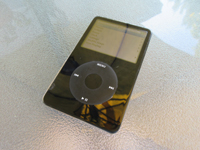
Being a Neanderthal means I don't always care for what's newest, but in this case, I took it a step further and decided that I really don't even care for something that's in new condition. Thank God for eBay. This particular device is a 30GB 5th-generation "iPod Classic" (model A1136), and is one of the later 5th-generation models (introduced in 2006) with an updated screen and improved functionality. I bought it for a little under $50 - a reasonable price for a used 5 in good condition. Sure, it's a little more expensive than the other mp3 players I had considered (which ranged from around $25 to $40), and it's already a decade and a half old. But hey, they don't make 'em like they used to, right? This iPod was $249.00 when new, and minus the expected scratches from previous use, it still works like new. Plus, in the mp3 player business, the iPod name is certainly hard to beat.
In a world full if iPhones and iPads, the term "iPod" is rarely heard today. Apple stopped making standalone music players in 2017, and the only new "iPod" still available today is the current-generation iPod Touch, which is essentially a smartphone without a data plan. In the early 2000's, the term "iPod" was basically synonymous with "mp3 player". iPods were the cool new thing that everybody wanted, and they undoubtedly helped put Apple, the "fruit company" that few cared about, on the general public's radar long before their computers begain to experience mainstream popularity. Digital audio players had existed for quite some time already, but the iPod revolutionized the industry with an unprecedented balance of portability and functionality. It paved the way for several generations of mp3 player technology, including today's widely used iTunes application.
Those who have seen older iPods are certainly familiar with the iconic click wheel design, which itself had evolved throughout the various iPod generations and was eventually retired after the 6th generation in favor of touchscreens. The more I play with this iPod, the more I'm convinced that this wheel is a truly innovative design that is better than both traditional buttons and modern touchscreens. Like a touchscreen, it allows all functions to be operated by simply sliding a finger to the right spot. But like traditional buttons, it never leaves you with any doubt of what command your finger is about to trigger and provides clear feedback to let you know when you've triggered a command - in other words, it can be operated while blindfolded! It turns on and does everything it's supposed to do instantly with pretty much no delay, combining the speed, simplicity, and reliability of an old CD player with all the benefits of a modern mp3 player.
Yes, newer Apple devices can do so much more with the same amount of space. But why pay for more when less is all you need? This iPod was made well before you needed an Apple ID to do just about anything on an Apple device, so there's no worries about internet connectivity, data plans, syncing accounts, identity theft, or being tracked for statistical purposes. Yes, that means putting songs onto the device actually requires plugging it into a computer with iTunes installed - a process that's admittedly a bit more complicated than that of the other mp3 players I considered, which simply read songs in folders off a USB drive. But in this case - a little complexity is actually a good thing. iTunes is capable of identifying music by not only albums and track titles, but also artists, genres, and other useful information, making it much more versatile and user-friendly than most other mp3 player software. Of course, I downloaded an older (pre-Apple ID) version of iTunes specially for this purpose; it offers all the benefits of iTunes without all the unnecessary complexities. Just as the click wheel represents the golden era of mp3 player controls, the older versions of iTunes, both as a computer software and as an iPod operating system, represents the golden era of mp3 player software. The only major disadvantage of this iPod compared to most modern mp3 players is that it doesn't offer expandable storage. But honestly, 30 GB of built-in storage is enough to hold more music than you'll ever remember you have.
And it doesn't hurt that classic iPods are quite good-looking, even by modern standards. It's small enough to sit largely unseen on the living room bookshelf, but it's certainly attractive to look at when noticed. And even those who are most up-to-date on technology should appreciate not only seeing a fifteen-year-old gadget, but also seeing one being put to good use today. Plus, most audio critics today agree that the enhanced 5th generation iPod, which utilizes a Wolfson audio chip, has the best sound quality of any iPod, old or new. Honestly, I probably can't tell the difference without a high-end audio system. But it's good to know that I've chosen nothing short of the very best.
I'm glad to say that this iPod has left me absolutely satisfied with no regrets. With just a few simple clicks, I can turn my home into an island getaway, a meditative prayer room, a dance club, a magical forest, or a romantic restaurant. Plus, if I ever want to better take advantage of the iPod's audio quality, the current 3.5 mm speaker setup can easily be enhanced either by upgrading the speakers or by adding more splitters/speakers for even more of a surround feel. This is probably one of the best 50 bucks I've ever spent, and now it's time for me to go enjoy it!
01/18: I generally don't follow the news as much as I should, but I have to say it's quite disappointing to see our nation's Capitol practically shut down in anticipation of the presidential transition. This only serves to show the extreme depth of the fundamental issues plaguing our nation. Regardless of personal opinions and beliefs, the inauguration of a newly elected president should be a celebrated occasion - a welcoming of a new chapter in American history. Just like with any other major transition, many people will be hesitant to see change and reluctant to say goodbye to the past. But life keeps moving forward whether we want it to or not. And it's an absolute shame to see this time of change become a time of fear of violence and chaos. More and more of our people are stubbornly refusing to accept anything other than their own personal preferences, turning to whatever means seems necessary to get what they want. The good of the nation and the value of others' lives and well-beings, and the good of the nation as a whole, no longer seem to matter. And it really doesn't help that some of our leaders also stubbornly reject reality and openly express hostility toward others. Yes, our nation comprises of an increasingly diverse pool of individuals. But we can't forget that in the end, we're still one nation. "A house divided against itself, cannot stand." Lincoln's wise words are no less true today than they were over half a century ago. This constant game of tug-of-war among our own citizens will only hinder our nation and our leaders from making progress in any direction while many other countries across the world continue to grow and advance. There's no doubt that America is a world power, but if we want to remain that way, we need to actively uphold that title rather than sit back and expect it to uphold itself. This means we need to strive for unity and invest in our leaders rather than criticize them, even if they make mistakes or have different beliefs than we do. I pray for a safe and smooth transition, and that the new president and administration will strive to bring us back to our roots where we can exercise and enjoy our freedoms without losing sight of our unity as one nation.
|